
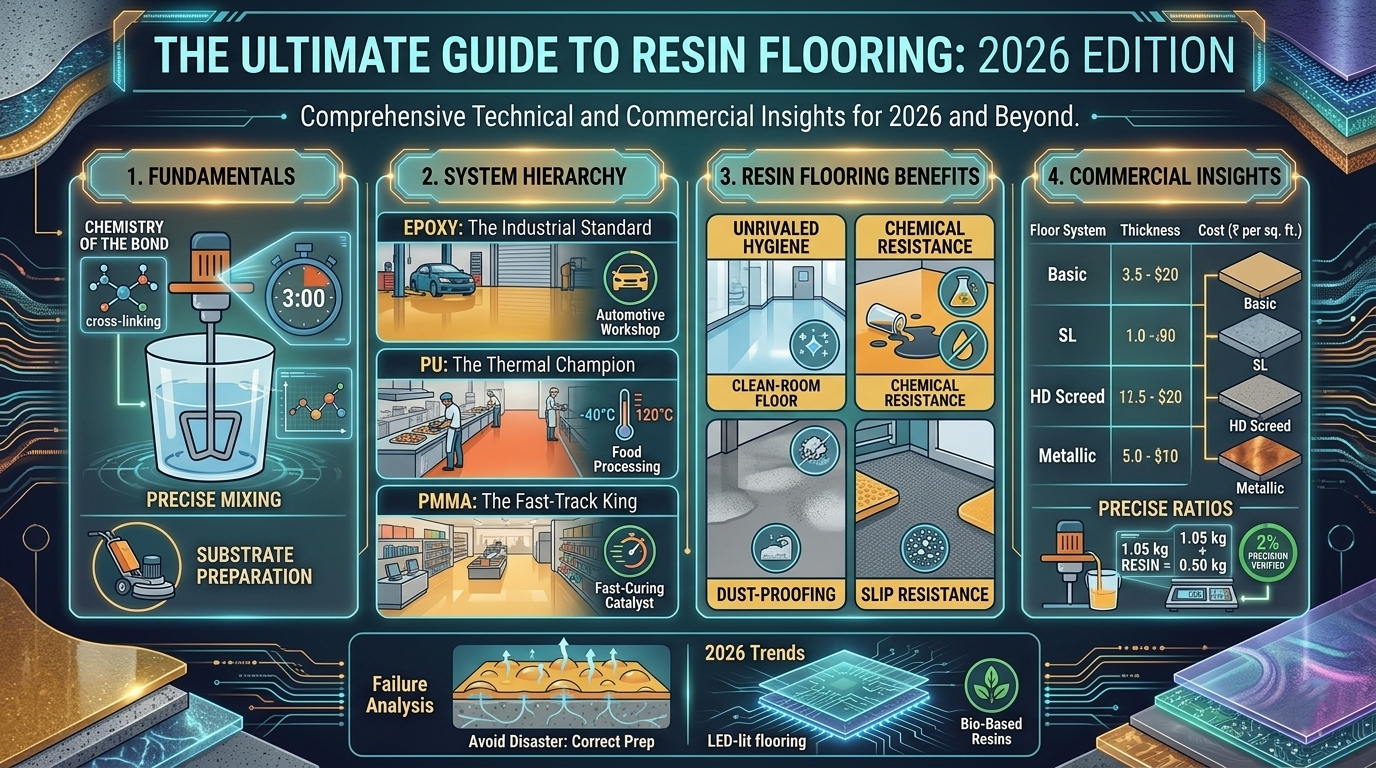
In the modern architectural landscape, the floor is no longer just a surface to walk on; it is a critical component of a building’s structural integrity, hygiene protocol, and aesthetic identity. Resin flooring has emerged as the premier choice for those seeking a seamless, high-performance alternative to traditional tiles, stones, or concrete.
Whether you are a facility manager overseeing a 50,000 sq. ft. warehouse in Pune or a luxury homeowner in South Delhi, understanding the intricacies of resin flooring is essential for a long-lasting investment. This guide breaks down every technical and commercial aspect of the resin industry as it stands in 2026.
1. What is Resin Flooring? (The Deep Dive)
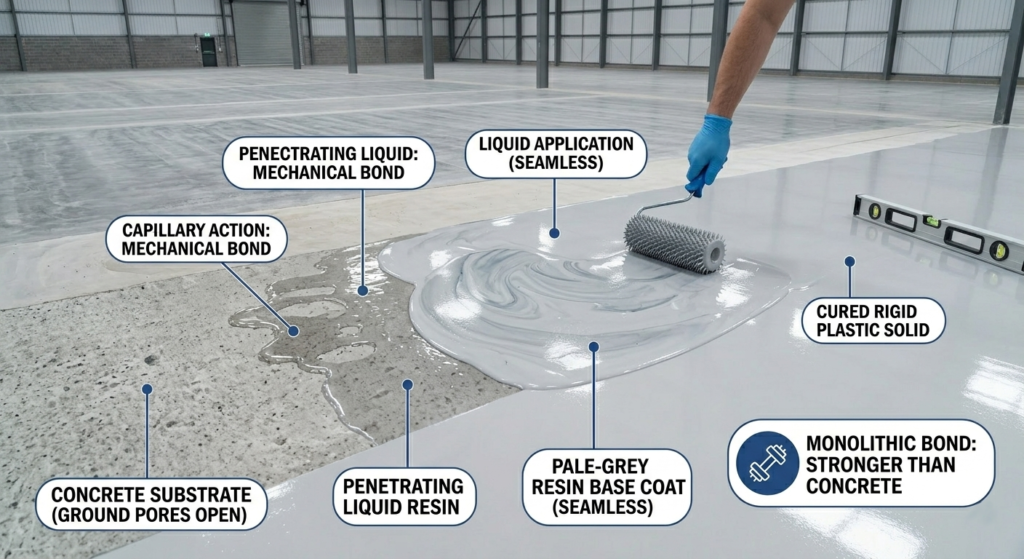
Resin flooring is a seamless, liquid-applied flooring system composed of synthetic resins and hardeners. When these two parts are chemically cross-linked, they transform from a liquid state into a rigid, non-porous plastic solid that is permanently bonded to the substrate (usually concrete).
The Chemistry of the Bond: Unlike tiles that sit on top of a floor using adhesive, resin creates a mechanical bond. During the preparation phase, the concrete’s pores are opened, allowing the liquid resin to penetrate deep into the capillaries of the slab. This creates a monolithic structure that is significantly stronger than the concrete itself.
2. The Hierarchy of Resin Systems
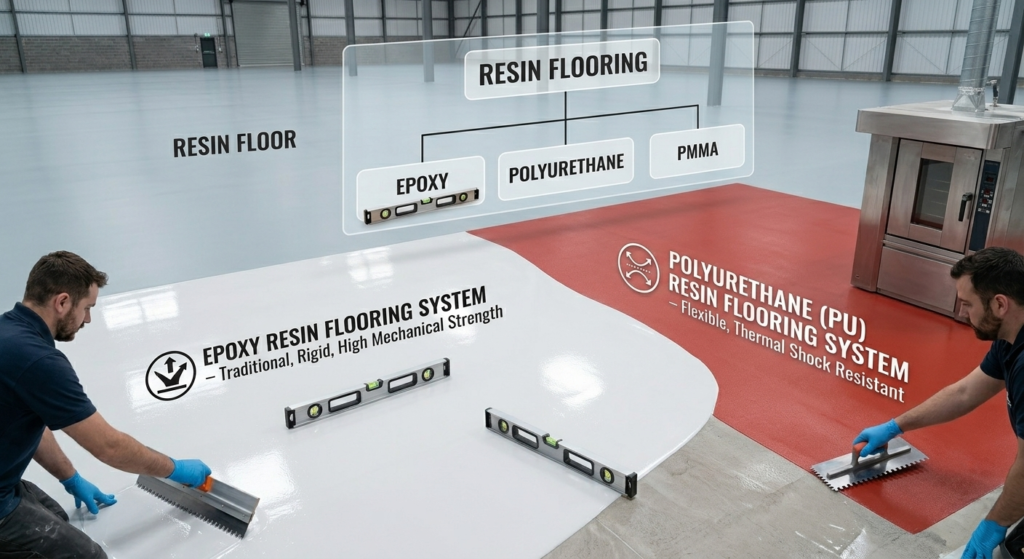
In 2026, the market is divided into four primary chemical families. Choosing the wrong one is the #1 cause of floor failure.
A. Epoxy Resin Flooring: The Industrial Standard
Epoxy is a thermosetting polymer. It is the go-to for epoxy resin flooring due to its incredible compressive strength and chemical resistance.
- Best For: Warehouses, automotive workshops, and labs.
- Pros: High gloss, exceptional hardness, and budget-friendly for large areas.
- Cons: Brittle; it can crack if the building settles or if exposed to thermal shock (boiling water).
B. Polyurethane (PU) Resin: The Thermal Champion
Polyurethane systems are “softer” and more elastic than epoxy. This flexibility allows them to expand and contract.
- Best For: Food processing (dairies, bakeries), cold storage, and car parks.
- Pros: Can withstand temperatures from -40°C to 120°C. High impact resistance.
- Cons: Higher material cost and sensitive to moisture during installation.
C. PMMA (Methyl Methacrylate): The Fast-Track King
PMMA is unique because it cures via a catalyst reaction in as little as 60 minutes.
- Best For: Retail stores, airports, and commercial kitchens that cannot close for 24 hours.
- Pros: Ultra-fast turnaround. UV stable (won’t yellow).
- Cons: Strong odor during application (requires ventilation).
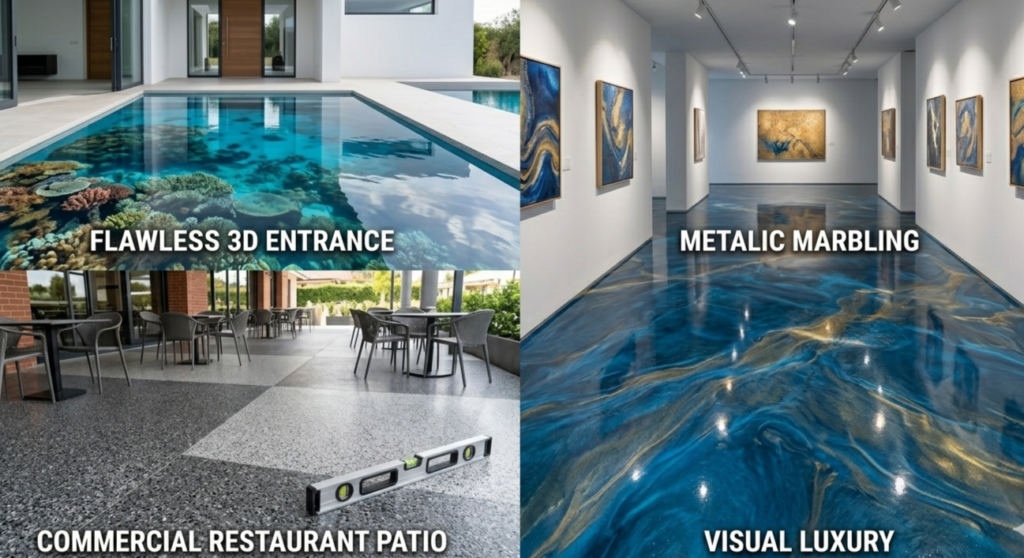
D. Metallic & 3D Decorative Resins
These are specialized versions of epoxy or polyaspartic resins used for high-end visual aesthetics.
- Best For: Living rooms, luxury offices, and art galleries.
- Pros: Unlimited design potential; can mimic marble, lava, or water.
3. The “Why”: Benefits of Resin Flooring
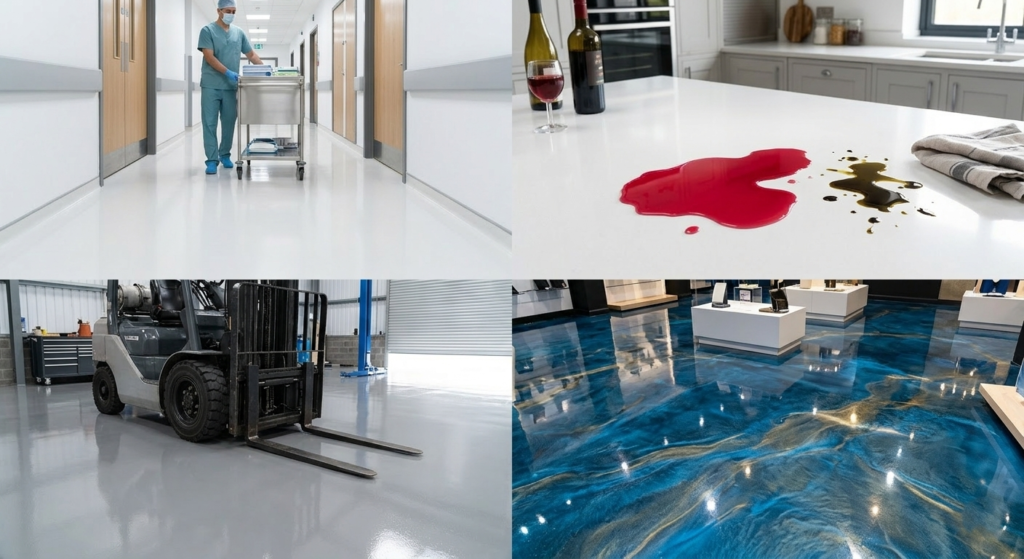
Why have searches for “benefits of resin flooring” increased by 40% this year?
- Unrivaled Hygiene: Traditional floors have grout lines where bacteria, mold, and dust accumulate. Resin is 100% seamless, making it the only choice for “Clean Room” standards.
- Chemical Resistance: From engine oil to industrial acids, high-quality epoxy resin floor systems are impervious to staining and structural degradation.
- Dust-Proofing: Bare concrete constantly “dusts” due to friction. Resin seals the concrete, keeping your environment (and sensitive electronics) dust-free.
- Slip Resistance: In 2026, safety is paramount. Resins can be “broadcast” with quartz or aluminum oxide to create a non-slip texture even when wet.
- Aesthetic Flow: Without joints, a space appears larger and more cohesive.
4. The “Cons”: What No One Tells You
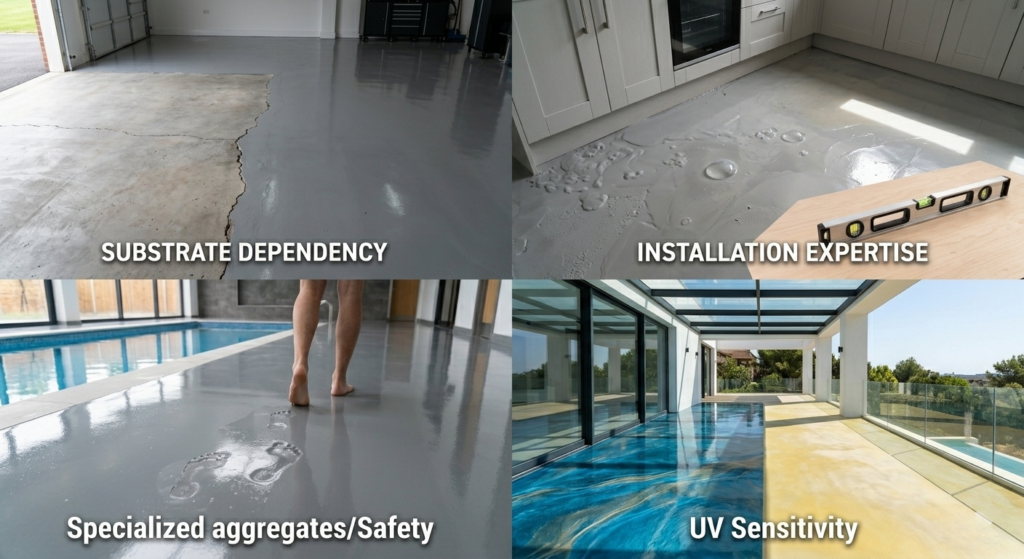
Every pillar page must be honest. Here are the drawbacks:
- UV Yellowing: Most standard epoxies will turn yellow if exposed to direct sunlight. You must specify a UV-stable Polyaspartic or PU topcoat for outdoor-facing rooms.
- Moisture Sensitivity: If your concrete slab has “rising damp,” the resin will eventually blister and peel. A moisture-barrier primer is an essential (but often skipped) step.
- Smell: During the “curing” phase, some resins release VOCs (Volatile Organic Compounds). Modern 2026 formulations are moving toward Zero-VOC, but ventilation is still required.
5. Installation: Why Professionalism is Mandatory
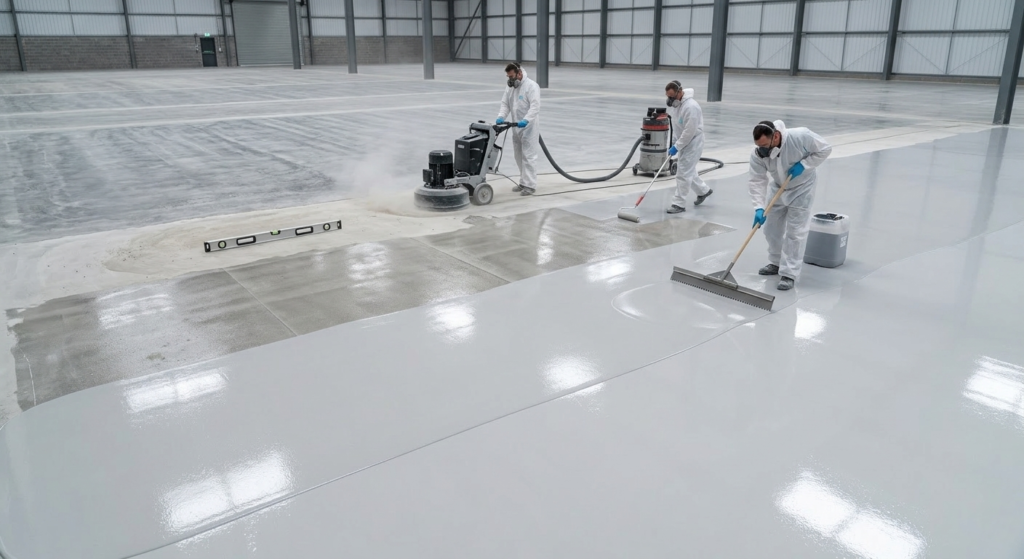
Installing a resin wall clock is a DIY joy; installing a resin floor is a technical operation. The process follows a strict 4-step protocol:
Step 1: Substrate Preparation (The Most Important Step): The floor must be Diamond Ground or Shot Blasted. This removes the “laitance” (weak top layer of concrete) and creates a “CSP” (Concrete Surface Profile) of 3 or 4. If the floor is smooth, the resin will fail.
Step 2: Priming: A low-viscosity resin is applied to soak into the concrete. This prevents air bubbles (pinholes) from rising into the final coat.
Step 3: The Body Coat: This provides the thickness and color. For industrial floors, this might be 2–3mm thick. For metallic resin floor designs, this is where the artistic pigments are swirled.
Step 4: The Top Coat: A final protective layer—either matte, satin, or gloss—to provide scratch resistance and UV protection.
6. Resin Flooring Price in India: 2026 Budgeting
Costs vary significantly between metropolitan hubs (Mumbai, Bangalore, Delhi) and Tier-2 cities due to logistics and skilled labor availability.
| Floor System | Thickness | Cost (₹ per sq. ft.) | Durability |
| Basic Epoxy Coating | 0.5 mm | ₹45 – ₹75 | 3-5 Years |
| Self-Leveling (SL) Epoxy | 2.0 mm | ₹90 – ₹160 | 10+ Years |
| Heavy-Duty PU Screed | 4.0 mm | ₹180 – ₹280 | 15+ Years |
| Metallic / Marble Effect | 3.0 mm | ₹350 – ₹600 | Lifetime |
| 3D Graphic Floor | 3.0 mm | ₹500 – ₹950 | Lifetime |
Note: Prices include material and professional labor. Always add a 10% buffer for surface preparation of old concrete.
7. Common Failure Analysis: How to Avoid a Disaster
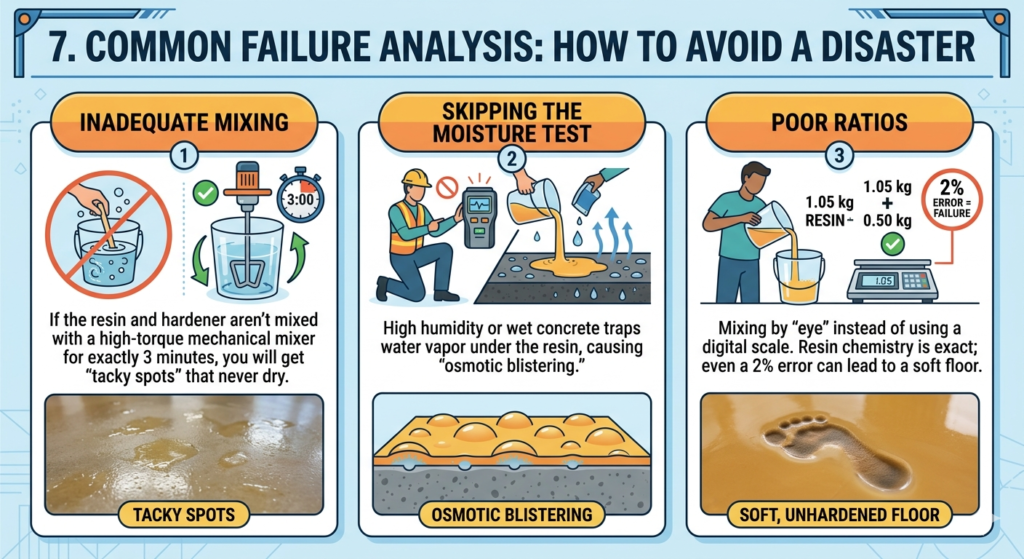
If you see a resin floor peeling, it’s usually due to one of these “Big Three” mistakes:
- Inadequate Mixing: If the resin and hardener aren’t mixed with a high-torque mechanical mixer for exactly 3 minutes, you will get “tacky spots” that never dry.
- Skipping the Moisture Test: High humidity or wet concrete traps water vapor under the resin, causing “osmotic blistering.”
- Poor Ratios: Mixing by “eye” instead of using a digital scale. Resin chemistry is exact; even a 2% error can lead to a soft floor.
8. The Future: Resin Trends in 2026
- Bio-Based Resins: Formulations made from plant-based polymers rather than petroleum.
- Conductive (ESD) Flooring: Essential for the growing semiconductor and EV battery manufacturing plants in India.
- Translucent Layers: Layering clear resins with LED strips underneath for “glow-in-the-dark” pathways.
Conclusion: Making the Right Choice
Resin flooring is a high-tech solution for a high-tech world. While the initial investment is higher than basic tiling, the long-term ROI—found in lower maintenance, superior hygiene, and incredible durability—is unmatched.
When planning your project, remember: The product is only 50% of the result; the other 50% is the preparation.